
A Practical Guide to Production-Grade AI (and How to Choose the Right Architecture)
Overview
Most enterprise AI initiatives stall because the system around the model can't scale—GPU capacity is scarce or expensive, data pipelines can't feed training fast enough, inference can't meet latency SLOs, and teams can't reliably ship updates. Gartner forecasts that 30% of GenAI projects will be abandoned due to cost and data-quality issues. Meanwhile, IDC reports AI infrastructure spending reached ~$90B in Q4 2025, with accelerated servers capturing ~94.3% of spend. The message is clear: scaling is now an infrastructure-and-operations problem as much as a data science one.
This guide breaks down AI infrastructure scaling into what architects can design and engineering leaders can execute:
(1) core requirements for compute, storage, and networking,
(2) how AWS, Azure, and GCP accelerate enterprise AI scaling, and
(3) how MLOps pipelines and Kubernetes for AI operationalize reliability.

Core Infrastructure Requirements
AI infrastructure scaling starts with sizing the workload reality—training vs. fine-tuning vs. inference—then mapping it to compute, storage, and network primitives.
1) Compute (GPUs/accelerators + scheduling)
For large training and fine-tuning, cloud GPU families such as AWS EC2 P5 (NVIDIA H100) provide dense acceleration options suitable for distributed training. For frontier-scale builds, AWS introduced P6e-GB200 UltraServers. For cost-optimized training/inference, purpose-built accelerators can reduce unit cost—AWS Trn1 for training [7], AWS Inf2 for inference.
2) Storage (throughput beats capacity for training)
Training is typically gated by data throughput and metadata efficiency. High-performance file systems such as Amazon FSx for Lustre are designed to feed GPU clusters and unlock higher bandwidth to GPUs for DL workloads. On GCP, Filestore offers managed file storage with performance guidance published for throughput and IOPS planning.
3) Networking (distributed training & east-west traffic)
At scale, network latency becomes a model-quality and cost issue: slow gradient synchronization wastes expensive GPU time. AWS EFA is built to improve communication efficiency for HPC/ML workloads. Azure's GPU VM families are designed for large-scale training; Microsoft's sizing documentation for ND MI300X v5 indicates enterprise-class configurations for high-end workloads.
Pattern-based insight: "Pilot-to-Prod fintech"
A leading fintech moved from a single-GPU proof-of-concept to multi-node fine-tuning. The bottleneck wasn't GPU count—it was data staging. By shifting training data to a parallel file system (Lustre-class) and adding low-latency networking, they reduced "GPU idle" time and stabilized training windows.
Actionable steps
- Separate training and inference compute pools; tune each for different utilization and scaling curves.
- Treat storage as a performance system—profile input pipeline throughput before buying more GPUs.
- Define SLOs (training time-to-result, inference p95 latency, availability) first; back into architecture from SLOs.
- Avoid mixing ad-hoc instance types in the same distributed training job; heterogeneous nodes amplify stragglers.
Reference deployment choices
Scaled AI platform blueprint
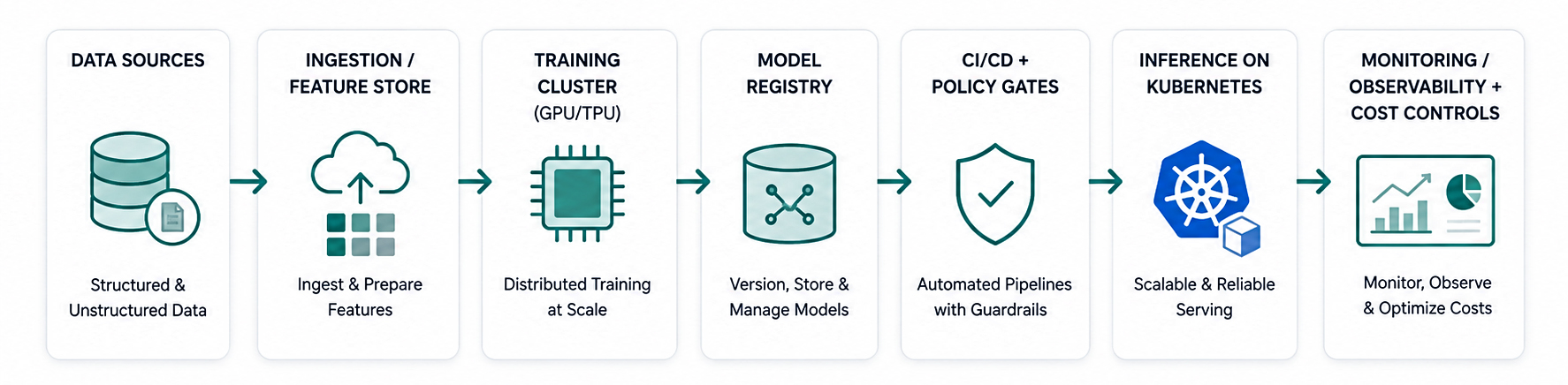
Cross-cutting lanes: IAM, encryption, network segmentation, audit logging.
Why Cloud Platforms Accelerate AI Scaling
Cloud doesn't magically fix scaling—but it compresses time-to-capacity and standardizes platform building blocks into reusable patterns.
AWS: broad accelerator menu + ML/HPC networking For GPU-heavy training, P5 and P6 families offer a runway from multi-GPU nodes to UltraServer concepts for larger models. For inference economics, Inf2 is explicitly positioned for lower-cost, high-performance inference. For distributed training, EFA provides a proven option to reduce communication overhead without bespoke networking buildouts.
Azure: enterprise governance + reference architectures Azure publishes sizing guidance for modern GPU VM families like ND MI300X v5. For platform standardization, AKS reference architectures and AI/ML guidance provide repeatable baselines. Microsoft's public AI reference architectures repository can accelerate design selection and security alignment.
Google Cloud: TPU + GKE production blueprints GCP's documentation covers GPU support and accelerator-optimized machines. For TPU-based paths, TPU v5e documentation supports cost/performance planning. Google also publishes a GKE inference reference architecture as a "blueprint for production-ready inference", useful for standardizing rollout patterns.
Pattern insight: "Streaming personalization at scale" Hyperscalers popularized the pattern: containerized inference behind autoscaling, with strict SLOs and continuous rollout. The transferable enterprise lesson is the platform approach: standardized deployment templates + governed model promotion. Using GKE's inference blueprint as a baseline can reduce design churn and accelerate approvals.
Next steps
- Pick one "default" cloud for your first production lane; multi-cloud can come later when your platform is stable.
- Use managed Kubernetes (AKS/GKE) to standardize runtime; reserve bespoke VM clusters for specialized training.
- Secure GPU quota and regional availability early—capacity constraints can derail timelines. Document fallbacks (e.g., alternative instance families).
- Require a reference architecture decision record (ADR) per use case—compute choice, network topology, data location, and SLOs.
How OptimEdge fits: OptimEdge Cloud & Platform Engineering helps you choose and implement the right scalable AI architecture across AWS/Azure/GCP, codify it in infrastructure-as-code, and establish guardrails (networking, IAM, cost controls) so teams can ship safely.

Operationalizing with MLOps & Kubernetes
Once infrastructure exists, the primary scaling constraint becomes repeatability: can you ship models weekly, rollback safely, and prove compliance?
MLOps pipelines (the production "supply chain") A practical pipeline includes:
1) data validation → 2) training/fine-tuning → 3) evaluation gates → 4) packaging → 5) registry/promotion → 6) deployment → 7) monitoring/feedback.
Cloud-native reference materials reinforce this shift toward production-grade inference architectures and managed Kubernetes as a control plane for releases [53][67]. Kubernetes becomes the consistent runtime for services, batch inference, and even distributed training operators (when appropriate).
Kubernetes for AI: why it works
- Standardized deployment: same primitives for canary, blue/green, HPA, and policy enforcement.
- Isolation: per-namespace tenancy, network policies, and workload identity patterns.
- Portability: a model service can move across AKS/GKE with minimal app changes; cloud-specific integrations are isolated to platform modules.
Governance and observability Monitoring isn't just CPU/GPU—it's model behavior: drift, data skew, and performance regression. Cost controls must be part of the pipeline: tagging, budgets, and automated shutdown of ephemeral training stacks. Cost pressure is consistent with Gartner's abandonment drivers.
Next steps
- Treat models like software artifacts—semantic versioning, immutable images, and signed promotion between environments.
- Add "policy gates" to MLOps pipelines (security scan, data residency check, evaluation thresholds).
- Standardize on a template (Helm/Kustomize) to avoid snowflake services.
- Use a shared platform backlog: platform team builds paved roads; product teams consume them.
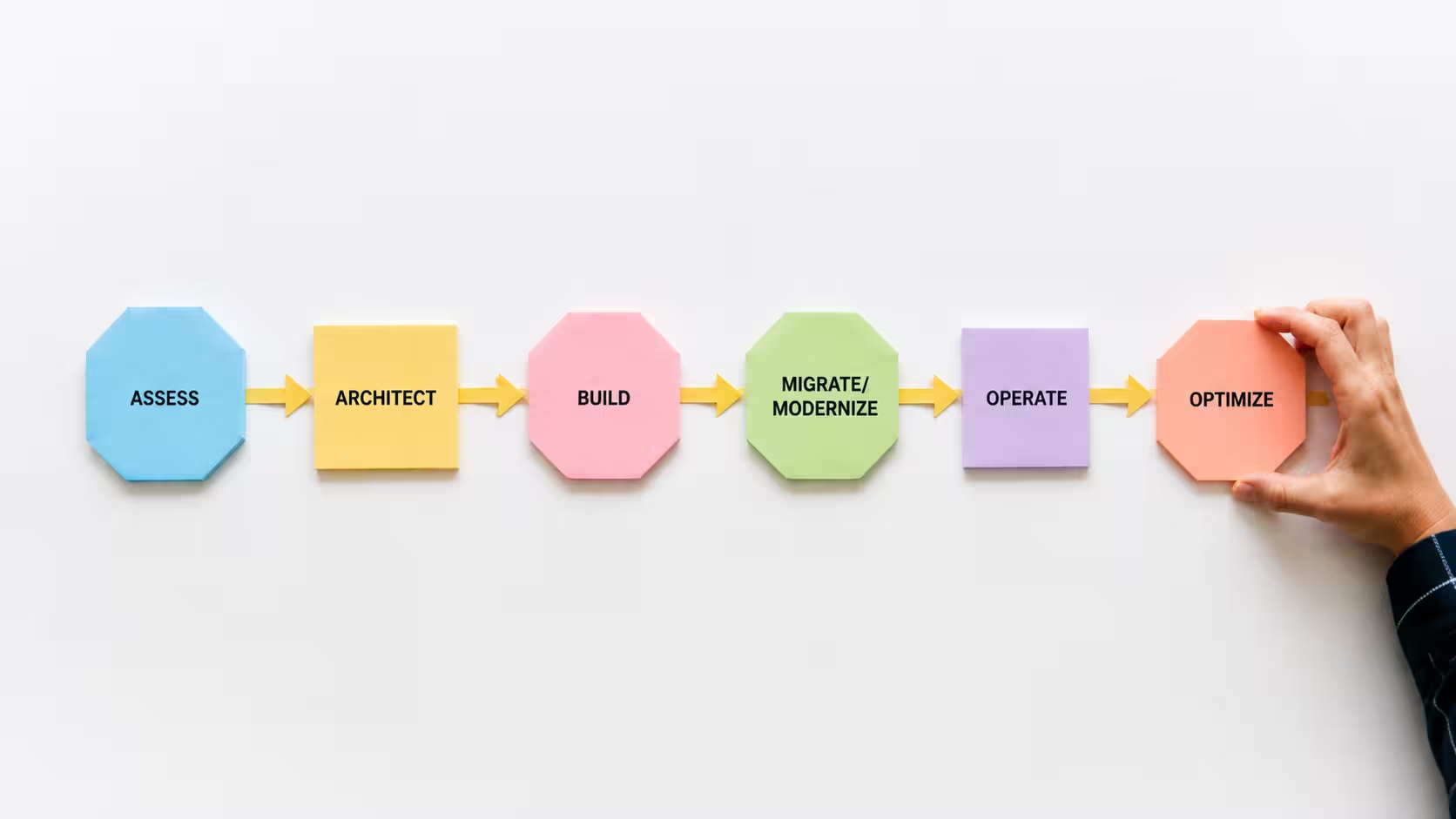
How OptimEdge fits (six-stage engagement motion) OptimEdge typically applies a six-stage approach to
enterprise AI scaling: Assess → Architect → Build → Migrate/Modernize → Operate → Optimize.
The result is a reusable platform: landing zone + Kubernetes baseline + MLOps pipelines + observability and cost governance.
AI Infrastructure Scaling Checklist
- Define SLOs for training time-to-result, inference p95 latency, uptime, and data freshness.
- Choose a reference architecture: training cluster, inference runtime (Kubernetes), and data plane (file/object/warehouse).
- Validate network design for distributed training (low latency / high throughput options like EFA).
- Implement MLOps pipelines with promotion gates and rollback.
- Establish security baseline: IAM, encryption, segmentation, audit logs, secrets management.
- Add FinOps guardrails: quotas, tagging, budgets, and automated lifecycle controls.
Next step
Sources
- https://cloudprice.net/aws/ec2/instances/p5.4xlarge
- https://cloudprice.net/aws/ec2/instances/p5.48xlarge
- https://aws.amazon.com/ec2/instance-types/trn1
- https://docs.aws.amazon.com/AWSEC2/latest/UserGuide/efa.html
- https://aws.amazon.com/blogs/aws/amazon-ec2-inf2-instances-for-low-cost-high-performance-generative-ai-inference-are-now-generally-available
- https://aws.amazon.com/ec2/instance-types/inf2
%20copy.jpg)
About the Author
Frequently Asked Questions
Use workload separation (train vs. infer), right-size accelerators (e.g., Inf2 for inference), and enforce pipeline-driven lifecycle controls. Plan for capacity early to reduce premium "last-minute" procurement.
Not for every workload, but it's the fastest way to standardize deployment, rollout, and policy controls. AKS and GKE both publish reference guidance for production patterns.
Usually no. Start with one primary cloud lane to stabilize your platform, then add portability requirements once you can operate reliably.