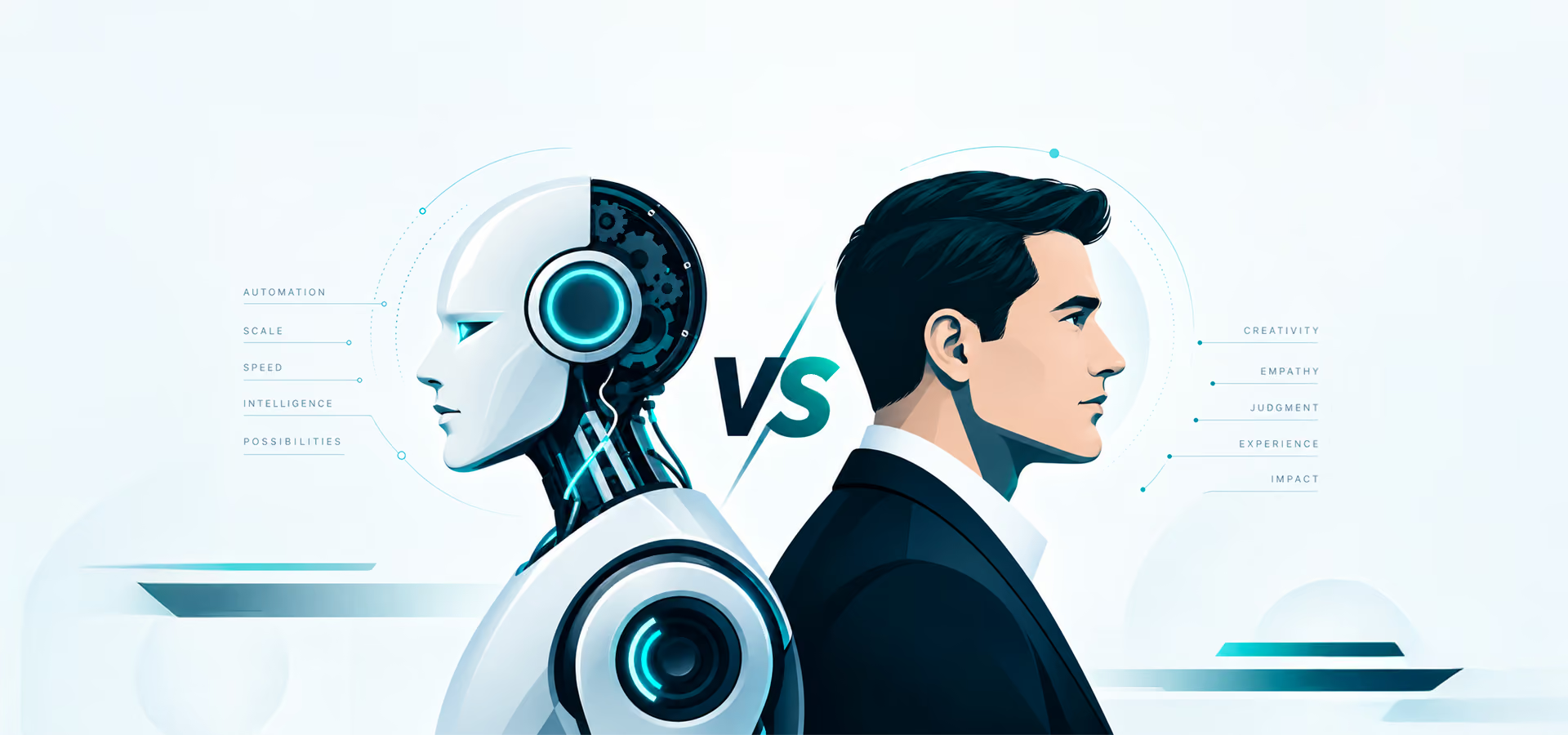
How Does AI Consulting Compare to Traditional IT Consulting?
The Core Difference: Systems vs. Intelligence
Traditional IT consulting is optimized for implementing and operating deterministic systems—software and infrastructure that should behave the same way today as tomorrow once configured correctly.
Typical activities include:
- Requirements gathering, solution selection, and program management (e.g., ERP/CRM)
- Infrastructure and platform modernization (networks, servers, cloud migration)
- Systems integration, data migration, testing, and cutover planning
- Change management, training, and operating model design
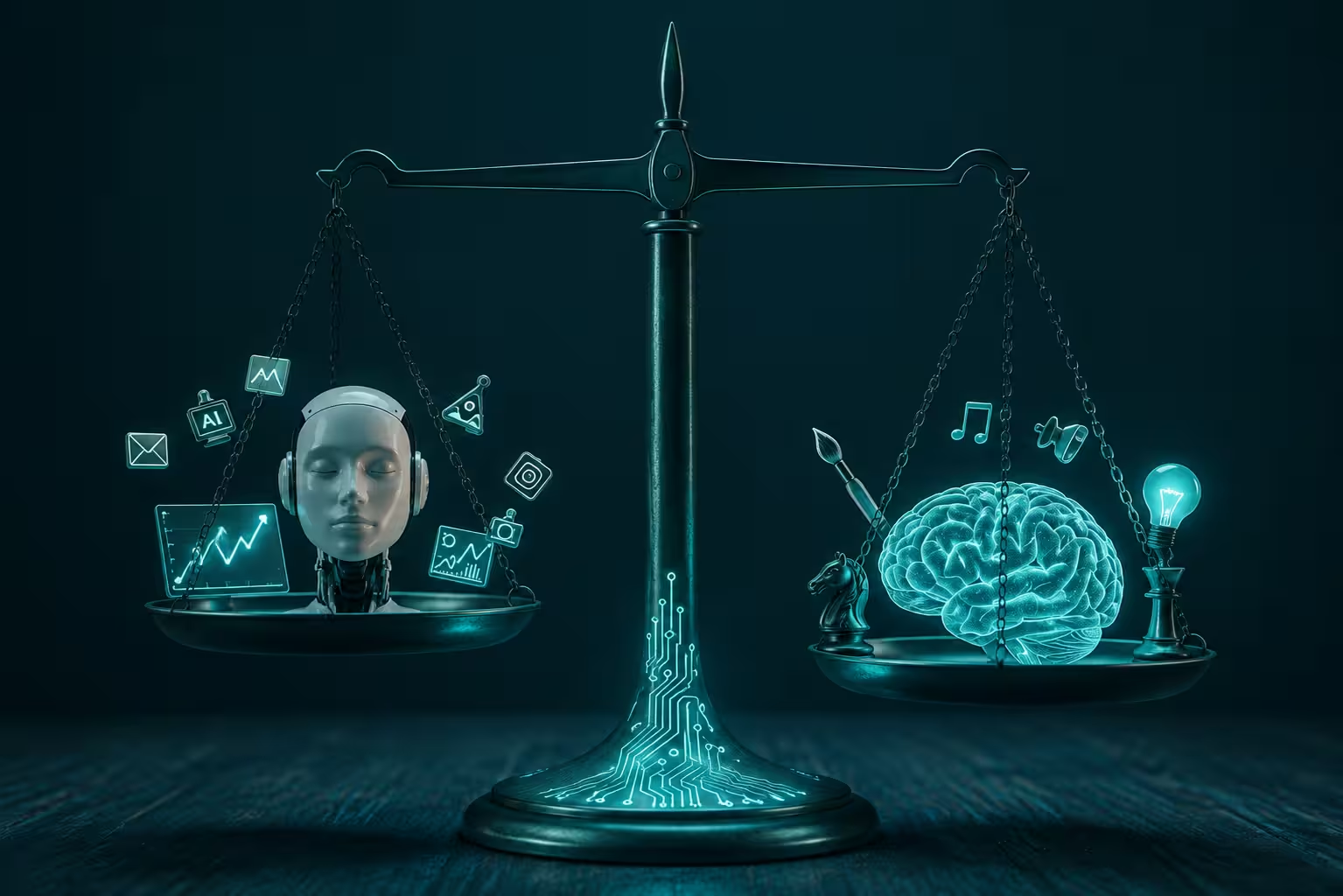
AI consulting is optimized for delivering probabilistic capabilities—models or agents that infer, predict, or generate outputs based on data and can degrade if the world changes.
Typical activities include:
- Use-case prioritization tied to measurable outcomes (cost, throughput, risk)
- Data readiness and feature engineering; evaluation design and baselines
- Model selection/training or LLM orchestration; prompt and retrieval design
- MLOps/LLMOps: monitoring, drift detection, retraining, and governance controls
- Human-in-the-loop workflows and policy design for safe decision automation
Working decision vs. working system (the practical takeaway):
- Traditional IT consulting aims to ship a working system (e.g., "ERP is live and transactions post correctly").
- AI consulting aims to ship a working decision (e.g., "maintenance tickets are predicted with validated precision/recall, monitored for drift, and audited for compliance").
Time-to-value also differs. Mid-sized ERP rollouts typically run 18–24 months in many organizations Gartner Peer Community poll: ERP timeframe, and Panorama reports ~17.4 months on average with frequent overruns Panorama ERP report archives. By contrast, task-specific AI agents reached pilot-to-production in a median ~5.1 months in 2026, with top-quartile deployments under 3 months per IDC Paul Okhrem AI agent stats and IDC AI pivot whitepaper—but many AI efforts stall at proof-of-concept (discussed below).
Where They Overlap
Despite differences, the best engagements share core consulting disciplines:
- Outcome-first scoping (business case, KPIs, stakeholders).
- Architecture and integration (AI still depends on identity, APIs, data platforms, and workflow tools).
- Security and compliance (access control, logging, vendor management).
- Change management (AI changes decisions; ERP changes processes—both require adoption design).
- Operational readiness (runbooks, incident response, service ownership).
OptimEdge LLC supports these overlaps through practical advisory and execution that bridges AI and enterprise foundations. AI initiatives often fail without upfront AI readiness planning and a clear AI Strategy—and those must connect to the existing IT roadmap, not sit beside it as "innovation theater." (Internal links: AI Strategy, AI readiness)

When You Need AI Consulting Specifically
Choose AI consulting when the problem requires learning from data or generating content—not just automating a known workflow.
Common signals:
- You need prediction or optimization (e.g., predictive maintenance for a manufacturing line, forecasting failures from sensor data). This requires model evaluation, drift monitoring, and lifecycle controls—not just app configuration.
- You want automation of knowledge work with GenAI (summarizing cases, drafting responses, extracting fields). Governance must address reliability, privacy, and IP leakage; Gartner notes many organizations are deploying GenAI, increasing the need for controls Gartner press release on GenAI deployment.
- Your ROI depends on continuous performance (models decay when customer behavior, equipment conditions, or fraud patterns change). Model drift is a known operational reality, and ongoing monitoring is required IBM on model drift.
- You need an AI governance program aligned to recognized frameworks, such as the NIST AI RMF (Govern, Map, Measure, Manage) NIST AI RMF PDF and/or ISO/IEC 42001 for an AI management system Microsoft compliance overview: ISO 42001.
- You are struggling to move beyond prototypes. Multiple sources report that ~88% of AI prototypes/ML initiatives stall at proof-of-concept or fail beyond pilots IDC AI pivot whitepaper and Netguru MLOps vs DevOps. S&P Global also reports many businesses scrap AI initiatives year over year CIO Dive summary citing S&P Global.
Time-to-value estimate (practical): A well-scoped AI pilot can often prove value in 8–16 weeks, but production-grade rollout typically lands in the 3–6 month range for focused use cases, consistent with IDC top-quartile deployment and 2026 agent stats IDC AI pivot, Okhrem.
When Traditional IT Consulting Is Sufficient
Traditional IT consulting is the right tool when the value is primarily in standardization, control, and transaction integrity.
Examples:
- ERP rollout or modernization (finance, HR, supply chain). These are long-horizon transformations where the risk is dominated by scope, integrations, data migration, and change management. Panorama reports average mid-sized ERP implementations around 17.4 months, with many exceeding timelines Panorama ERP report archives.
- CRM implementation where success is adoption, workflow configuration, and reporting (Forrester TEI benchmarks are often around ~9–10 months in many CRM programs per research summaries referenced in the findings; where exact numbers vary, treat as directional).
- Core infrastructure and platform work (network redesign, IAM standardization, backup/DR, endpoint management).
- Compliance-driven projects where requirements are explicit and largely deterministic (audit logging, retention policies, segregation of duties).
Even here, AI can be added later—once data quality and process maturity are in place.
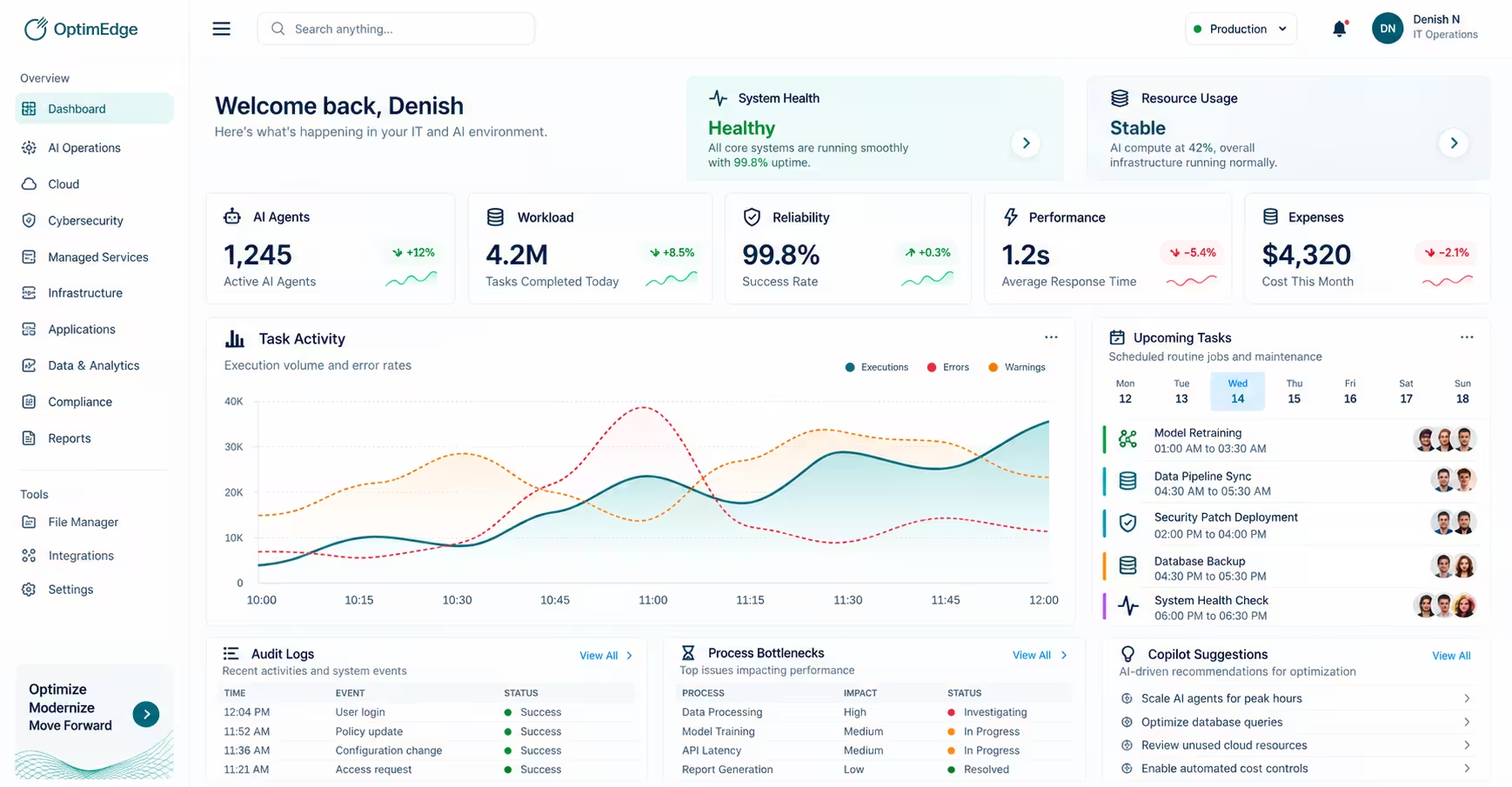
The Hybrid Reality: AI-Enabled IT Consulting
Most organizations don't choose "AI or IT consulting." They need a hybrid operating model where AI capabilities are embedded into modern platforms securely and run reliably.
This is where OptimEdge LLC's blended capability matters: AI + Cloud + Cybersecurity + Managed Services delivered as one coordinated engagement. In practice, hybrid delivery means:
- Standing up scalable data and application foundations through Cloud Engineering (internal link: Cloud Engineering) so AI can access governed data and deploy with repeatable pipelines.
- Applying Cybersecurity & Governance (internal link: Cybersecurity & Governance) to cover AI-specific risks: data exposure, model supply chain, prompt injection, identity controls for agents, and auditability aligned to NIST AI RMF NIST AI RMF PDF and ISO/IEC 42001 Microsoft ISO 42001.
- Designing for "run" from day one: Gartner notes that only a portion of AI projects sustain operationally for multiple years even in mature organizations Gartner AI maturity operational longevity. Managed Services closes the gap between a successful pilot and dependable production.
Bottom Line
Use this decision framework:
- Is the outcome deterministic (transaction accuracy) or probabilistic (decision quality)? If probabilistic, start with AI consulting.
- Is your data actually usable and governable? If not, invest first in AI readiness and platform foundations, then pilot. (AI readiness)
- Do you need production reliability, security, and continuous improvement? If yes, choose a hybrid partner that can build and run—especially when regulatory exposure or sensitive data is involved (NIST AI RMF; ISO/IEC 42001) NIST AI RMF PDF, Microsoft ISO 42001.
If you want a pragmatic roadmap that ties use cases to measurable outcomes and a secure operating model, start with an AI Strategy assessment and then sequence the work across cloud, security, and managed operations AI Strategy.
Sources
- https://www.gartner.com/en/newsroom/press-releases/2025-07-15-gartner-forecasts-worldwide-it-spending-to-grow-7-point-9-percent-in-2025
- https://www.gartner.com/en/newsroom/press-releases/2025-11-10-gartner-survey-finds-artificial-intelligence-will-touch-all-information-technology-work-by-2030
- https://www.linkedin.com/posts/waynehorkan_gartners-2025-hype-cycle-for-enterprise-activity-7381099432777392128-P_uJ
- https://www.pragmaticcoders.com/blog/gartner-ai-hype-cycle
- https://cdn.prod.website-files.com/68e2953718576ae8097b7cfd/68efaff129a48a7e8d0fdde3_Gartner%27s%20AI%20Cycle%202025.pdf
- https://unicoconnect.com/blogs/ai-statistics-2026
%20copy.jpg)