.avif)
AI Scaling Strategy: A Five-Phase Roadmap from Pilots to Production
Overview
Enterprise leaders aren't struggling to start AI, they're struggling to scale it. While ~88% of organizations use AI, only ~33% have scaled beyond pilots. Gartner-backed reporting shows only about half of AI models make it into production, revealing how often delivery breaks down between proof of concept and reliable service.
This roadmap is for C-suite, VPs, and directors responsible for enterprise transformation, operating-model change, and platform decisions—leaders who need a plan that balances speed with risk management.
You'll learn how to connect AI investments to workflow redesign and EBIT impact—because, as McKinsey's State of AI reporting suggests, many executives see ROI early, but far fewer realize enterprise-level financial impact.
Assess (Phase 1): Prove the "Why," Audit Readiness, and Define Success
Objective: Establish a value-backed, risk-aware foundation before you spend political capital on a pilot. The key output is clarity: which use cases matter, what "good" looks like, and whether the organization can reliably support pilot-to-production.
Key activities
- Use-case portfolio triage: Prioritize 5–10 candidate use cases using a scoring model—value potential, feasibility (data/tech), risk (regulatory/reputation), and adoption readiness.
- Data readiness audit: Inventory data sources, lineage, access controls, quality gaps, and ownership. Gartner's AI-ready data warning is a practical forcing function here: weak data foundations are a leading predictor of abandonment.
- Operating-model alignment: Identify who owns product outcomes, model risk, and production support. Decide where centralized vs. federated AI delivery makes sense.
- Success criteria + measurement plan: Define baseline metrics and target lift. Many AI efforts fail to deliver expected value due to misunderstood problem definitions and poor data quality—so success criteria must be explicit, measurable, and tied to decisions and workflows.
Milestones
- AI use-case portfolio and prioritized backlog approved by business and IT
- Readiness gaps documented (data, skills, architecture, governance)
- Signed-off "definition of success" for the first pilot (business + risk + tech)
Sample deliverables
- AI opportunity map (value vs. feasibility)
- Data readiness scorecard + remediation backlog
- Initial AI metrics framework (business, model, adoption, risk)
Governance and risk management
- Create an AI system inventory and classify use cases by risk tier (e.g., customer-impacting, regulated decisions).
- Align early with NIST AI RMF concepts—especially Map (context, impacts) and Govern (accountability).
- If you're pursuing formal assurance, map controls to ISO/IEC 42001 requirements for AI management systems (policies, oversight, lifecycle documentation).
Common pitfalls
- Selecting use cases based on novelty ("GenAI demo") rather than workflow value—Gartner predicts many GenAI initiatives will be abandoned when value is unclear.
- Skipping baseline measurement—making ROI impossible to prove later.
- Treating readiness as a checklist rather than a remediation plan with owners and dates.
Tip: In Assess, insist on a single-page "AI Value Hypothesis" per use case: decision/process impacted, target users, baseline metric, expected lift, and failure mode.
Design (Phase 2): Engineer for Scale—Architecture, Data Pipelines, and Governance-by-Design
Objective: Turn assessment insights into a scalable blueprint—reference architecture, data pipelines, security, and enterprise AI governance that will support pilot-to-production repeatedly, not just once.
Key activities
- Reference architecture for AI delivery: Define patterns for batch vs. real-time inference, integration points (CRM/ERP/contact center), and environment separation (dev/test/prod).
- Data pipelines + feature/knowledge management: Design ingestion, quality checks, and lineage. For GenAI, define RAG/knowledge sourcing, content provenance, and refresh cycles.
- MLOps + deployment design: Standardize CI/CD for models, approvals, and rollback strategies. "Half of models never make it to production" is often a process problem as much as a modeling problem.
- Governance model: Establish an AI steering group and working committees (security, legal, risk, HR, data). Gartner frames governance as embedded practice—"governance by design" rather than a separate afterthought.
- Control mapping: Map controls to NIST AI RMF (Measure and Manage) and ISO/IEC 42001 (documentation, oversight, lifecycle controls).
Milestones
- Approved AI reference architecture and integration patterns
- AI governance charter and RACI (who approves what, when)
- Control requirements embedded in delivery pipelines (logs, auditability, human oversight)
Sample deliverables
- AI architecture decision record (ADR) pack
- Data quality SLOs and monitoring plan
- Responsible AI policy pack: human-in-the-loop triggers, privacy, transparency, vendor requirements
Governance considerations
- Risk tiering: High-impact use cases require stronger review gates, bias testing, and incident response playbooks.
- Lifecycle documentation: ISO/IEC 42001 emphasizes lifecycle management and documentation controls that can reduce audit friction later.
- Vendor and model supply chain: Define rules for third-party models, IP, and data handling.
Common pitfalls
- Building a bespoke architecture per pilot (cannot scale).
- Over-indexing on tooling without ownership (no product owner, no run team).
- Treating governance as a "sign-off committee" that slows delivery instead of guardrails that speed safe deployment.
Warning: If governance is not automated into pipelines (logging, approvals, monitoring), it will either be ignored—or it will become the bottleneck.
Pilot (Phase 3): Deliver a Measurable MVP and Prove Adoption, Not Just Accuracy
Objective: Validate the business hypothesis quickly with an MVP that can realistically transition to production. This phase is where many organizations get stuck—pilots succeed in demos but fail in operations.
Key activities
- MVP scope and hypothesis testing: Define what the pilot will prove—productivity lift, cost reduction, risk reduction, or revenue impact.
- Rapid iteration loops: Run short cycles with end users and process owners; redesign workflow steps, not just model outputs. McKinsey commentary on AI impact often stresses that value comes when organizations redesign how work happens—not when they merely "add AI".
- Data and evaluation readiness: Establish test sets, acceptance thresholds, and drift expectations.
- Pilot-to-production checklist: Design the pilot so it can be hardened—security review, observability, audit logs, and fallbacks.
Time-to-production expectations
Many enterprise AI initiatives take 6–12 months from kickoff to production, with data prep consuming much of the time; simpler solutions may ship in weeks, while enterprise ML systems can take 12–18 months. Use that benchmark to set executive expectations and avoid "pilot theater."
Milestones
- MVP in a real user workflow (not just a sandbox)
- Measured lift vs. baseline (with statistical/operational confidence)
- Go/No-Go decision with documented evidence and a scale plan
Sample deliverables
- Pilot scorecard (business + model + adoption + risk)
- Operational readiness report (security, performance, support model)
- Training and enablement plan for target user groups
Common pitfalls
- Optimizing only for model metrics (AUC, accuracy) while ignoring adoption and process change.
- Inadequate data quality remediation—one of the recurring causes of AI value shortfalls.
- No production owner: pilots built by innovation teams without a "run" organization.

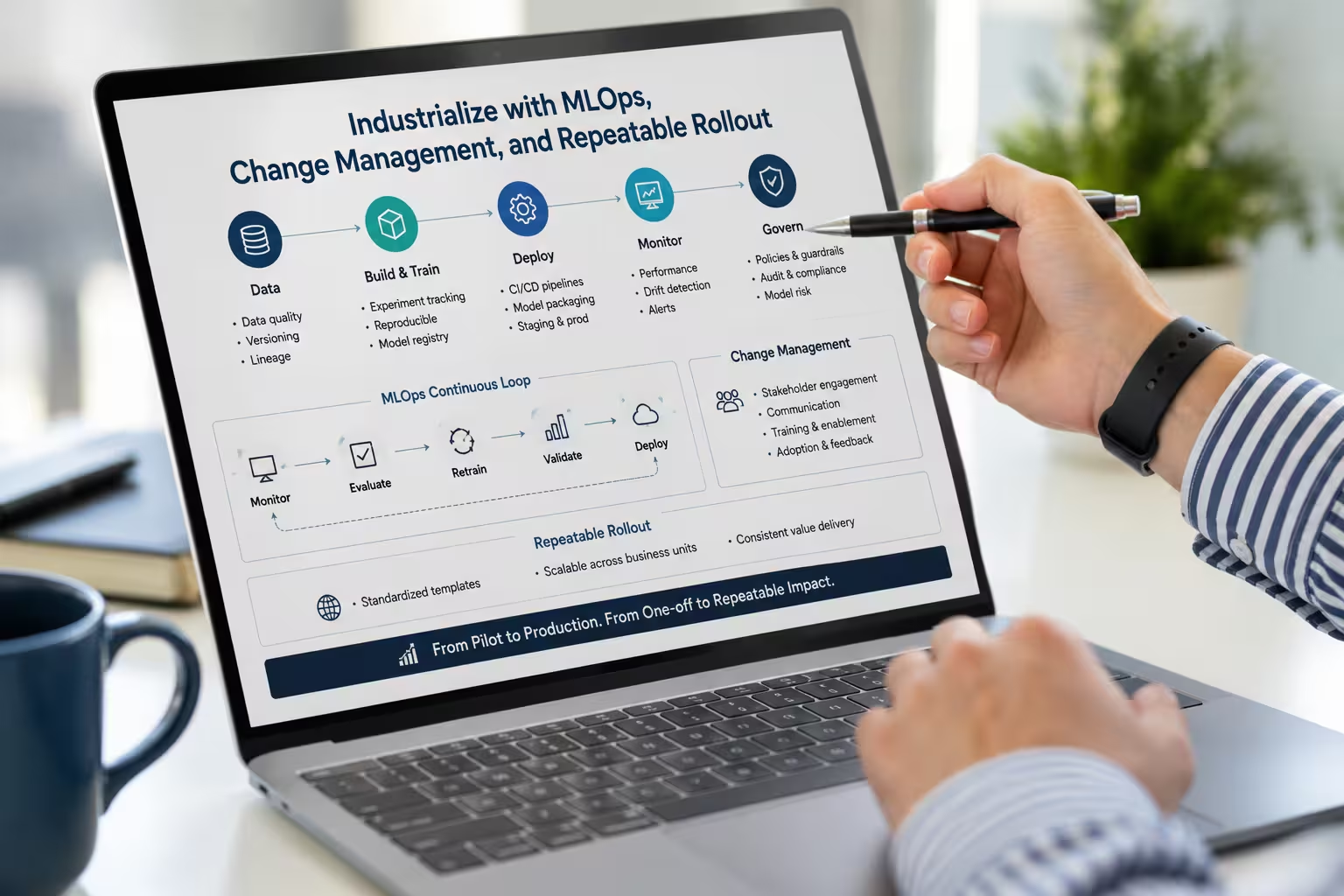
Scale (Phase 4): Industrialize with MLOps, Change Management, and Repeatable Rollout
Objective: Convert a successful pilot into an enterprise capability—standardized deployment, operating procedures, support, and change management so the next use case is faster and safer.
Key activities
- Production-grade MLOps: Automated testing, model registry, deployment approvals, rollback, and environment parity.
- Enterprise rollout: Expand by region, business unit, or segment; define onboarding playbooks and communication plans.
- Change management and training: Adoption is a leading indicator of value realization. O'Reilly reporting has highlighted that production adoption is materially lower than experimentation (e.g., production rates around the teens in some enterprise snapshots).
- Risk controls at scale: Implement incident response, monitoring, and compliance evidence collection. Deloitte positions trustworthy AI controls and assurance as a necessary capability to scale with confidence.
- Portfolio governance: Move from "one pilot" to a managed backlog with quarterly prioritization tied to business strategy.
Milestones
- Production deployment with SLAs/SLOs (availability, latency, quality)
- Support model (L1–L3), runbooks, and incident processes live
- Second and third use cases launched using the same platform patterns (proof of repeatability)
Sample deliverables
- MLOps runbook + on-call procedures
- AI deployment playbook (technical + business rollout)
- Benefits tracking dashboard tied to finance and operations
Common pitfalls
- Scaling a model without scaling the process (no training, no workflow redesign).
- Underestimating data operations costs—data quality issues are a known scaling blocker and a driver of abandonment [3][6].
- Treating risk review as a one-time event rather than continuous monitoring.
Optimize (Phase 5): Monitor, Retrain, Govern Continuously—and Keep Proving Value
Objective: Ensure AI systems remain accurate, safe, compliant, and valuable over time. Optimization is where an AI scaling strategy becomes a durable competitive capability rather than a one-off program.
Key activities
- Monitoring and observability: Track performance, drift, data quality, latency, and cost. For GenAI, add hallucination indicators, citation coverage (for RAG), and safety filters.
- Continuous improvement loops: Retraining cadence, prompt/knowledge updates, feedback labeling, and post-incident reviews.
- Value realization and reinvestment: McKinsey-linked reporting suggests many executives see first-year ROI, but fewer achieve enterprise EBIT impact. Closing that gap requires ongoing workflow refinement and reinvesting saved time into higher-value work.
- Governance maintenance: NIST AI RMF is explicitly iterative across Govern–Map–Measure–Manage; ISO/IEC 42001 similarly emphasizes continuous improvement of the AI management system.
- Lifecycle decisions: When to retire models, replace vendors, or rebuild with new data and constraints.
Milestones
- Live AI KPI dashboard reviewed monthly (business + risk + tech)
- Quarterly model review board decisions: retrain, recalibrate, retire
- Audit-ready evidence pack generated automatically (logs, approvals, testing outcomes)
Sample deliverables
- Monitoring dashboards (model + product + adoption)
- Model cards / system documentation updates aligned to your governance policy
- Post-deployment benefits report tied to finance metrics
Common pitfalls
- "Set and forget" deployments—drift and data changes erode performance.
- Measuring only cost savings; ignoring risk, customer experience, and adoption.
- Not upgrading governance as scope expands into higher-impact use cases.

AI Metrics That Scale (Example Dashboard Categories)
Checklist: Preview the AI Scaling Roadmap
Assess
- Prioritized use-case portfolio with value hypotheses
- Data readiness scorecard and remediation owners
- Baselines + success metrics defined (business, adoption, risk)
Design
- Reference architecture and integration patterns approved
- Governance charter + RACI + risk tiering established
- Controls mapped to NIST AI RMF and/or ISO/IEC 42001 requirements
Pilot
- MVP in real workflow; user feedback loop active
- Pilot scorecard proves lift vs. baseline
- Pilot-to-production checklist completed (security, observability, fallback)
Scale
- MLOps pipelines + runbooks + SLAs in place
- Rollout plan (training, comms, support) funded and staffed
- Benefits tracking dashboard tied to finance
Optimize
- Drift + performance monitoring live; retrain cadence defined
- Quarterly governance reviews and audit evidence automated
- Continuous workflow redesign plan to expand impact
AI Scaling Roadmap Template (PDF)—a fillable roadmap covering phases, milestones, metrics, and governance gates.
Next Steps
Book a meeting to work with an end-to-end partner who takes you from strategy to "run," using a six-stage delivery process (strategy → data → build → validate → deploy → run) designed for non-disruptive adoption.
Sources
- https://talyx.ai/insights/enterprise-ai-implementation-failure
- https://astrafy.io/blog/scaling-ai-from-pilot-purgatory-why-only-33-reach-production-and-how-to-beat-the-odds
- https://olakai.ai/blog/ai-pilot-to-production
- https://sranalytics.io/blog/why-95-of-ai-projects-fail
- https://www.gartner.com/en/newsroom/press-releases/2025-02-26-lack-of-ai-ready-data-puts-ai-projects-at-risk
- https://www.linkedin.com/posts/ntnaggarwal_experiencefromthefield-writtenbyhuman-activity-7338403777432981504-jf7s
%20copy.jpg)
About the Author
Frequently Asked Questions
Common causes include unclear problem definition, poor data quality, missing infrastructure, and lack of success metrics and ownership. Gartner-aligned reporting also points to AI-ready data gaps as a major driver of abandonment, and surveys indicate only about half of models reach production.
Benchmarks commonly land in the 6–12 month range end-to-end, with wide variance: simpler solutions can ship in weeks, while enterprise ML systems may take 12–18 months depending on data and governance complexity. Use these ranges to set expectations and design phased rollouts.
Many enterprises use both: NIST AI RMF provides an iterative risk management structure (Govern, Map, Measure, Manage), while ISO/IEC 42001 defines requirements for an AI management system and can support certification-ready controls and documentation. The right choice depends on regulatory exposure, audit needs, and maturity.